Interview of the Charge d'affaires of Belarus in Belgium S.Panasiuk to RIA Novosti (February 26, 2026, Brussels)
- How would you describe the relations between the Republic of Belarus and the European Union today? Can we talk about the existence of a united “collective West”?
- Today, it is difficult to talk about preserving the concept of a “collective West” in its common sense. We definitely see transformation of the notion in this regard and Europe is no longer a unified entity. Therefore, in order to understand what kind of relations Belarus has with the European Union, we need to understand what part of the European elite we are building these relations with.
We see the processes taking place in Europe today and the differences in opinion. For example, in February of this year, the Budapest Global Dialogue conference was held in Budapest, where the Hungarian Foreign Minister Péter Szijjártó was present. He called for a turn towards realism and national sovereignty, noting that the future will be bilateral and sovereign, rather than supranational and ideological. Today, Hungary pursues a foreign policy that is open in all directions, maintaining channels of dialogue with the U.S., Russia, China and Turkey.
The elite that currently determines the direction of the European Union's foreign policy in Brussels is focused on sanctions, pressure, and the subjugation of member states to European unity. These EU steps, i.e., militarization and the imposition of ideological dogmas – are leading to Europe's gradual isolation from the main centers of the emerging multipolar world.
Therefore, if we look at Europe, we see a version, which still adheres to old narratives and does not take into account the obvious changes that are taking place in the world today and are recognized by everyone. Then, of course, due to the fact that this project is becoming less attractive ideologically, it is necessary for current EU elite to use such means as sanctions, pressure, militarization and threats of military force.
Relations between Belarus and the EU are not in top shape today. But the Republic of Belarus consistently adheres to an independent, sovereign foreign policy, based on the interests of the Belarusian people. And we will not go along with restoring these relations in a way that would be detrimental to our national interests. We see the prospect of normalizing these bilateral relations only on an equal basis. This should include an abandonment of unilateral illegal restrictive measures and attempts to impose value narratives.
Therefore, we see the prospect of normalizing bilateral relations on an equal basis, based on several approaches, including those outlined during the conference in Budapest. In other words, it should be a departure from any unilateral illegal restrictive measures and attempts to impose certain value narratives that are not shared by traditional Belarusian society.
This process will continue, and Belarus will patiently and consistently pursue this policy. We hope that in the foreseeable future, the European Union's approaches to Belarus and to the overall security architecture in the region will be adjusted to take into account the realities of the changed world that everyone is observing today.
- Do you think that Brussels' current foreign policy is based primarily on sanctions and pressure?
- Sanctions are still being imposed, this policy continues. Very soon, Brussels will again extend sanctions against Belarus. So, unfortunately, the EU is not ready to change this track yet. Here, of course, in international affairs our priority is patience. This probably belongs to our Chinese friends and partners. This is a nation that really thinks in terms of 50 or 100 years ahead, as they have repeatedly demonstrated. Belarusians are probably a little more dynamic in this regard, and we would, of course, like to achieve certain results as soon as possible. But we also know how to develop long-term policies.
We understand that the changes currently taking place in the world, the formation of a fair multipolar world order, is a process that takes time. We must be patient and consistently work towards achieving this goal. And, of course, at present we do not see any signals that there is an intention of EU to move away from the sanctions mindset.
What can be said in this regard? First, we can express regret that this situation is still happening today. And it should be noted that few people think about the scale of what is happening. After World War II, the United Nations was formed to ensure a conflict-free balance of interests.
Today, we can start calling it the “United sanctioned nations organization (USNO)” as about 50 countries are under sanctions now and at least another 50 are indirectly affected by secondary restrictive measures. These states are incurring unreasonable costs and losses as a result of illegal sanctions pressure. Perhaps time has come to unite, calculate damages and present the bill to those who impose such restrictions in order to restore balance.
If we look at the negative effect of sanctions from the point of view of humanitarian consequences, it is surprising that we practically do not see demonstrations in democratic Europe against sanctions that harm ordinary people – causing illness and problems with access to medicine, food etc. The most dangerous thing is that many people have become accustomed to ignoring the illegal and inhumane nature of these measures. We know many cases when supplies of medicines, medical equipment, and other humanitarian goods have been blocked.
Sanctions are an outdated tool that needs to be changed. In many ways, the brand of sanctions hides blatant unfair competition. We have faced numerous cases when, after sanctions were announced, some people, including European businessmen, tried to line their pockets under the guise of sanctions. This is a common practice.
We know about the decisions of our neighbors, including the Baltic countries, which banned the supply of medicines, held them up at customs, including for patients, and did not allow access to insulin, medical equipment for cancer patients, and rare medicines. This was done in order to harm a specific group of the population under the pretext of restoring democracy.
In fact, Belarus has been under sanctions since 1996. For 30 years, the European Union, trying to make Belarusians “happy,” has simply violated their basic rights with these sanctions, and a generation of people has grown up whom Brussels wanted to make happy, but instead it has been strangling them with sanctions for 30 years at this pretext.
- What consequences does this have for Europe itself?
- Perhaps the Europeans themselves should think about the fact that these approaches need to be adjusted. What is particularly absurd is that the sanctions have consequences for Europeans themselves, for example in the fields of energy, logistics, and trade. When it comes to why there are no demonstrations against the applications of sanctions, why there are also no protests about rising energy prices or other specific consequences of these sanctions for the countries that impose them, this is also a very good and correct question.
In January, we held a conference in Brussels on the negative impact of unilateral coercive measures on specific individuals and human rights. It was attended by representatives of the European Parliament, European experts, and lawyers. And in the expert format of the discussion, it is clear that there is an understanding that sanctions are an illegal, outdated tool of coercion and interference in internal affairs of other states, a mechanism for changing undesirable regimes. There is also an understanding that they directly affect people, leading to illnesses and even deaths when access to rare medicines is restricted.
However, it is surprising that no basic legal assessment has been carried out to determine whether such restrictive measures comply with international law, including humanitarian law. The mechanism is being applied without proper assessment of the consequences, and the question of compliance with the UN Charter and other universally recognized norms is effectively being ignored.
To put it a bit more cynically, one could say: fine, if you in Europe don't care about the fate of Belarus, we understood that long ago. But why aren't Europeans concerned about their own well-being?
In this regard, we can mention the article by the Minister of Foreign Affairs of Belarus Maxim Ryzhenkov, entitled “Why I believe that something will change in Lithuania soon.” In fact, this appeal to the Lithuanian people contains a huge number of specific factors that show the negative effect sanctions have on the socio-economic development and well-being of the inhabitants of Lithuania. This applies to access to cheap electricity, supply of wood products and cargo flows in ports. I will not list everything.
According to our calculations, if relations with Belarus were normalized, the Lithuanian economy could add at least $1 billion to its GDP, which is currently being lost. If we remember that Lithuania's military budget already reaches almost 5.4% of GDP, it turns out that up to a quarter of the budget is already being spent on military expenses. Taking into account the losses due to sanctions, these are huge figures that are not being counted by specific Lithuanian citizens and that are not being directed to education, healthcare and social purposes. At the same time, our military spending in Belarus is about 1% of GDP, the country's budget remains socially oriented, and we are not going to attack anyone. So, who is a threat to whom?
We find our neighbors' position completely incomprehensible. The situation is similar in other Baltic countries. Citizens of Poland and Northern European countries also experience the negative effects. It is significant that the European Commission has considered and already decided on the need to allocate additional loans to regions, bordering Belarus and Russia. European institutions have recognized that the situation in these European border countries is difficult: economic hardship, population outflow, closure of enterprises, lack of new investment projects. The next seven-year EU budget provides for separate funds to compensate for these losses.
In other words, this is not only being said by the Belarusian side, but is also confirmed by data from the European Commission itself. Where are the interests of the European population being taken into account here? This situation is not beneficial to anyone. Herewith the goals of sanctions declared by the European side are also not achieved.
We can say that the masks have been dropped. Democratic screen is not applied any more. Economic pressure, unfair competition, and attempts to change unwelcome governments are not even masked with attempt to justify all this with ideological reasons.
Even the goals of sanctions (which we consider to be illegal interference in internal affairs), are not achieved. Unlike the Lithuanian economy, the Belarusian economy is developing steadily. We provide for economic growth. Disposable income of Belarusians (i.e., income minus mandatory payments and bank interest and adjusted for inflation), amounted to about 9.5–10% of growth last year. Of course, without sanctions, the rate would have been higher. There is a negative impact, but we are successfully reorienting ourselves and work with countries in the Global South and East, where no one imposes its development path on anyone else.
European taxpayers are incurring direct losses. Some European Union countries are directly affected by the application of these sanctions’ mechanisms, based on corresponding survey. According to some experts, the European Union's economic stability will last only for another 10–15 years if the current economic policy continues.
By rejecting energy resources supplied from the territory of Russian Federation, banning the supply of other materials, increasing its military budget, but at the same time having strong, high credit ratings, the European Union can continue to pursue the same policy for another 10-15 years, or even longer, without changing anything. But, what is next?
An interesting remark was made by Belgian Prime Minister Bart De Wever at a meeting with industrialists in Antwerp. He cited one figure: the number of regulators of all kinds of rules, formed by the European Commission, is twice the number of people engaged in innovation in various sectors of the European economy. If competitiveness is low and continues to decline compared to other players, then it may be necessary for EU to resort to sanctions to ensure competitive advantage. When it comes to the political dimension of pressure, its ideological cover is clear—the supposed desire to make Belarusians “happy.” It is surprising, however, why the European Union is so concerned about making Belarusians happy. It would be much more logical for the European Union to be concerned about how to make Europeans happy. But for some reason, they are very interested in Belarus.
- Representatives of the EU elite claim that Belarus is a threat. What can you say about this?
- According to the statements we see, they claim that Belarus allegedly poses a threat to them. With a certain amount of humor, one could say that Belarus, with its population of 10 million, is seen as a real threat by the European Union, with its population of 500 million. This means that either their armed forces are in very bad shape, or our military is so well that it poses such a threat in their eyes.
But seriously, how can one claim that a small European country poses a real threat to such a powerful block as the European Union? Nevertheless, the goal of “changing the regime” in Belarus is being declared. Such rhetoric in itself demonstrates a lack of respect for international law and ethics in relation to a sovereign state. The Belarusian side does not allow itself such formulations and, even with all the tension in relations, behaves with dignity.
If the goal is to ensure Europe's security by bringing forces to power in Belarus that are focused on raising the NATO flag, the question arises as to why Belarus should defend Europe. And most importantly, from whom? We must defend our country first and foremost. Those who promote such ideas, including the so-called opposition, don't openly name essence of goals behind this. They say that “democratic Belarus” will guarantee Europe's security, but, to call a spade a spade, we are talking here about a coup d'état and dragging our country into a conflict with the Russian Federation. This is a completely absurd inappropriate construct for us.
Official European figures do not put it quite so bluntly, but these statements are coordinated, and the opposition acts as a conduit for these ideas. The European side talks about an independent, sovereign, free Belarus. The opposition argues that only a free, democratic Belarus will guarantee Europe's security. But, If we are talking about Belarus not attacking on its own (as a country of 10 million people cannot pose a threat to a military bloc of 500 million), this implies that the threat arises from the union with the Russian Federation. Then the logic is as follows: break ties with Russia, cease to be a threat to Europe, and thereby become a threat to the Russian Federation. This may be convenient for Europe, but whether it will be good for Belarus – is of no interest to anyone in Europe, including our opposition, which is based there.
Public opinion polls, including those conducted by European think tanks, show that the ratio of supporters of the Union with Russia to those oriented towards Europe varies by a factor of ten. An incomparably larger number of Belarusians are in favor of maintaining relations with Russia, and their number has grown significantly over the past five years against the backdrop of the EU's unfriendly policies and sanctions. The number of those, oriented exclusively toward the EU, is extremely small. At the same time, our citizens do not advocate confrontation with anyone, including our Western neighbors.
We see no reason why we should not maintain good relations with Russia, China, Europe, the United States, and other countries on all continents. Our policy must be multi-vector and independent.
Belarus is linked to Russia by historical, cultural, and value ties. We share a common culture, traditions, and values, and we speak the same language with each other. Therefore, raising the question of severing these relations for the sake of someone's security seems strange.
Belarus is an independent state that pursues an independent foreign policy in the interests of its people. Perhaps it is not very convenient for the European side that our views on world processes largely coincide with those of Russia and China.
There were such statements, not from officials, but from individual commentators. After 2020, when the plan (of color riot) failed, some allowed themselves to make statements that it was no longer the «regime» that needed to be changed, but the Belarusian people, because they were «improper», as they think wrongly, react wrong, and keep wrong friendship ties. This clearly shows that the so-called «color revolution» did not succeed because it did not have the support of the majority of the population.
We are not saying that Belarus is perfect. We have issues that need to be addressed, we have shortcomings, and we are working on them. But it is fundamentally important that the state is focused on national interests and the interests of its people. This was discussed at the conference in Budapest, and it is also being discussed by some political forces in Europe, focused on national interests.
The problem is that the national interests of European countries are increasingly at odds with supranational ideological constructs. And this precisely leads to the current imbalances.
The attempt to separate Belarus from Russia, which has been at the forefront of the European Union's strategy towards our country for many years, is the main strategic mistake leading to imbalances and a negative trend in relations. As soon as the EU realizes that this issue needs to be removed from the negotiating table, it will give serious momentum to the establishment of an equal dialogue. Until then, this line of action continues to damage not only bilateral contacts, but also the security of the continent as a whole.
Even if we assume that the EU seriously considers Belarus a threat, which in itself has no rational basis, no anti-drone wall will protect anyone if there is no normal interaction with neighbors. It is much easier and cheaper to negotiate than to build barriers.
The point is not simply to sit down at the negotiating table every day and talk for several hours. The point is a political will and a willingness to take mutual interests into account.
- Is the dialogue with EU countries continuing along military lines?
- Such dialogue continues, including on issues of common European security. When the incident with drones flying into Polish territory occurred, we warned our Polish colleagues, as we continue to exchange information on the air situation. The military is cooperating.
The military understands where the real threat lies and how to respond. If this cooperation ceases completely, if the military stops interacting, it will be a serious problem. We have not reached that level yet. Contacts are maintained between the relevant services, including those responsible for counterterrorism, but the effectiveness of such cooperation is steadily declining, not on our initiative. We can talk often, but if we initially see each other as enemies, such talks will lead nowhere.
Contacts with neighbors are being maintained. For example, in order to de-escalate the situation, we proposed to the Polish side to conduct reciprocal inspections up to 80 kilometers deep as part of confidence-building measures in the military sphere. The Polish side refused. At the same time, European citizens can come to Belarus under a visa-free regime and see for themselves that the sanctions are not working as they are told. Let them come and see. They are told that everything is bad here, but they see shops, clean streets, and calm people. That is our answer.
Any militarization at the border is automatically viewed by military experts as a potential threat and provokes retaliatory measures. Perhaps it is not worth creating such conditions in an attempt to protect someone if it only increases tensions.
When the European side talks about security guarantees, it refers exclusively to Ukraine and Europe, while the interests of Belarus and Russia are hardly mentioned. The Republic of Belarus is interested in establishing peace in the region and in the earliest possible diplomatic resolution of the conflict on our southern borders. But when the European side talks about security guarantees for one of the parties, we do not hear any talk of such guarantees for Belarus, Russia, or other states.
If tensions remain in the region, it means that the principles laid down 80 years ago need to be adjusted in their application and returned to their “factory settings.” It is necessary to return to the concept of indivisible security and engage in substantive, equal dialogue, rather than labeling and using unilateral sanctions that have not been approved by the UN Security Council. The discussion should focus on guarantees for all countries in the region that are geographically present here and will shape this system.
- Is the EU willing to engage in dialogue with Belarus on the issue of a new European security architecture?
- So far, there has been no indication from the European institutions in Brussels that they are willing to restructure the dialogue with Belarus and review their approaches to regional security architecture.
We held a conference on security in Minsk last October. Then a conference was held in Brussels to discuss its results, with the participation of the diplomatic corps and European experts. Security architecture issues were discussed. There is a rule: “if you criticize, make a proposal.” We are not just saying that someone is not taking someone else's interests into account; we are proposing specific provisions contained in the Charter of Diversity and Multipolarity in the 21st Century. This document is set out in detail, including explanations from our Minister of Foreign Affairs. A broad dialogue on this Charter is currently underway.
We are saying outright that there was a certain model of interaction between the so-called collective West and the collective South and East, which had developed over centuries. Its colonial subtext was that cheap resources came from the South and East, were processed into high value-added products, and ensured a high level of prosperity for European countries. Today, this system no longer works: new centers of power and economic development are emerging in Asia, Latin America, and Africa, and competition is intensifying. The old security system does not take into account the legitimate interests of countries that want to take their rightful place in world affairs.
At the same time, Belarus does not question the foundations of international law. We proceed from the need for inter-state dialogue based on the UN Charter. But international law must return to its original principles, laid down after World War II. It should be a system of equal opportunities for states, based on dialogue between sovereign and independent countries, without dictates or attempts to ensure one's own security at the expense of others.
We have no border controls with the Russian Federation, no contingents of any kind. There are no contingents that are supposedly concentrated on the border between Belarus and Russia and “will march somewhere tomorrow.” These are absolute fakes that are sometimes thrown into the European information space. At the same time, Belarus feels completely safe on its eastern side. There is no need to build any walls.
But on our western borders, we see a build-up of forces. At the same time, we will not tire of repeating that the notorious German brigade, which is currently stationed 15 kilometers from Belarus in Lithuania, has the same number – 45 – as the Wehrmacht division that first attacked the Brest Fortress in 1941. But isn't that symbolic for us? The question arises: where should the threat come from – from the side where there are no fences and free movement is preserved, or from the side where forces and resources are being strengthened?
In military theory, there is the concept of a “security dilemma”: when one neighbor strengthens its armaments, the other is forced to respond in kind, and an arms race begins that can lead to hot conflict. Therefore, instead of building walls and bringing in troops, it is necessary to negotiate with neighbors and build normal relations.
Belarus will consistently promote the formation of a just multipolar world order. The number of countries that understand the processes taking place is growing. Perhaps there is a lack of coordination, but cooperation between like-minded countries is expanding, and this is an objective process.
Some issues have been inherited from the colonial era, when borders were drawn with a ruler, leading to territorial disputes and historical disagreements. We treat these issues with respect. But when it comes to promoting global solutions, it is sometimes necessary to make compromises in order to balance the security architecture on new principles, while relying on the UN Charter, and to begin moving towards normalization and peaceful coexistence between states — both in our region and on a global scale.
Speaking more broadly about security and prosperity, it is difficult to abandon a model that has ensured a high standard of living for centuries. People are accustomed to high social standards. There is a simple formula in economics: needs are unlimited, resources are limited. If in some countries the GDP per capita reaches 130-180 thousand euros per year, then somewhere there are countries where incomes are significantly lower.
I do not want to get into ideological discussions, and I am not against high incomes. But these should not be incomes at the expense of others; we need an equal condition of competition. There is a Gini coefficient that shows the gap between rich and poor. In a number of developed democratic countries, this gap is significant. In Belarus, one of the basic principles is social justice, and this gap in our country is one of the lowest in the region. This is not because we have no wealthy people and everyone is poor, but because we have no oligarchs and the state guarantees basic social rights — the opportunity to find work, access to healthcare, education, support for pensioners, people with disabilities, and families with children. Belarus ranks highly in key indicators assessed by the UN and other international organizations, including the Human Development Index. When we hear talk of restrictions on freedoms and human rights, it is worth looking at the specific figures. We rank very highly in Europe in a number of indicators, and are among the leaders in some. In 2025, for example, Belarus ranked 32nd out of 167 countries in the UN's international ranking of sustainable development goals. According to the IMF, Belarus' GDP per capita in purchasing power parity grew 9.5 times from 1995 to 2024, from $3,400 to $32,400.
- The EU constantly talks about “values” that other countries must adhere to. What exactly are these values?
- We ensure human rights of our people, but we have a different attitude towards «values». We are more conservative, and this is the choice of the people in Belarus. We want to have men and women. Men do not give birth to children. This is not a subject for ideological debate, but we believe that basic things are being blurred and people's attention is being deliberately shifted to agendas that are largely artificially created.
We are not interfering with anyone. The country's leadership has repeatedly emphasized that people are free in their personal lives. But we are against sex reassignment surgery for young children. This is unacceptable to Belarusians. At the same time, it is unacceptable to the European Union that this is unacceptable to Belarusians. This is where the conflict arises — they are trying to impose on us a model of life that they consider beneficial for us. But we want to decide for ourselves how we live, who we befriend, and what alliances we join.
If attempts to dictate our destiny were abandoned, it would be possible to reduce spending on walls, minefields, and anti-drone defense systems and redirect funds to medicine, education, culture, and the restoration of exchanges. This would be in the interests of both Belarusian citizens and EU citizens, especially those in border states.
As for the possible extension of sanctions, we can only say that this will be another year of missed opportunities to return to an equal dialogue with our neighbor. Belarus has been under sanctions since 1996. We are calm about this, we are reorienting commodity flows and maintaining economic indicators in cooperation with key partners – Russia, China, and countries of the global South and East.
When our European colleagues talk about the “isolation” of Belarus, one need only look at the geography of the contacts of the Head of State and the Minister of Foreign Affairs. The countries with which Belarus actively interacts represent the majority of the world's population. Therefore, the question remains: who is isolated today?
We are not interested in escalation. But if it continues, the Belarusian side will draw conclusions and reserves the right to take retaliatory measures, including asymmetric ones. Not all steps will be announced publicly.
It is our deep conviction that such a line does not serve the interests of the population of the European Union itself. It will lead to a further deterioration of the socio-economic situation, especially in border countries, including restrictions on movement and other measures that affect ordinary people.
With every unfriendly step, Europe loses Belarusian people, including young people, and by isolating itself from Belarus, it loses the support of that part of society that still has a neutral-positive view of relations with the EU. Such steps do not contribute to the development of ties, even if the desire for democratic transformation is declared.
Such measures do not contribute to the normalization and development of relations, even if it is formally stated that their goal is to promote democratic transformation. In practice, they have the opposite effect. Therefore, such decisions only cause regret and disappointment.
Nevertheless, Belarus intends to continue patiently and consistently conveying to its European partners its position on the counterproductiveness of sanctions pressure, as well as its peaceful aspirations and readiness to restore a truly inclusive system of indivisible security that takes into account the interests of all states in the region. The country's foreign policy remains based on the interests of the Belarusian people.
At the same time, Belarus is not closing its doors to the European Union. We are interested in a strong and prosperous EU — it is our neighbor. This is a given that we must continue to work with. We are interested in building normal good-neighborly relations with the European Union. We hear the opinions of those representatives and policy-makers who advocate resuming dialogue with Minsk. We welcome such statements and hope that common sense will prevail.
The Belarusian diplomatic mission in Brussels continues its work, despite the forced optimization of our diplomatic presence in Europe. We maintain dialogue and strive to create the conditions for the restoration of constructive relations, as this is in the interests of both Belarusian and European society.
We will continue to develop relations where we are welcomed, where alien narratives are not imposed on us, and where we simply interact on a basis of mutual respect. And that is a large part of the world's population. But here in the EU, too, we are working to lay the foundations for the resumption of dialogue, because this is in the interests of both Belarusians and Europeans.

Выступление Министра М.Рыженкова на открытых дебатах Совета Безопасности ООН // Statement by Minister M.Ryzhenkov at the open debate of the UN Security Council
Belarusian Vytsinanka has been inscribed on the UNESCO Representative List of Intangible Cultural Heritage
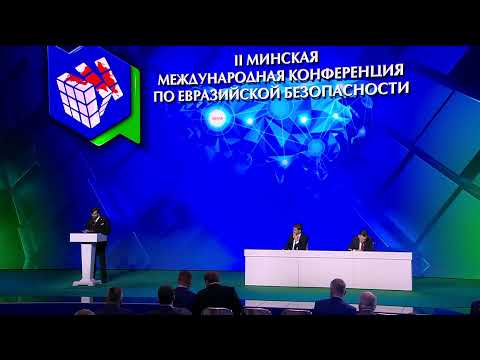
II Minsk International Conference on Eurasian Security
2023 in the history of Belarusian diplomacy
High-level International Conference on Eurasian Security
Statement by Foreign Minister Vladimir Makei at the 77th session of the UN General Assembly (September, 2022)


Official Internet Resources
President of the Republic of Belarus
www.president.gov.byCouncil of Ministers of the Republic of Belarus
www.government.gov.byCouncil of the Republic
www.sovrep.gov.byHouse of Representatives
www.house.gov.byNational Agency of Investment and Privatization
www.investinbelarus.byInternational ICT Forum TIBO
www.tibo.byNational Center of Legislation and Legal Information
www.center.gov.byNational Tourism Agency
www.belarustourism.byInformation export support website Export.by
www.export.byBelarusian Universal Commodity Exchange
www.butb.byBelarusian Chamber of Commerce and Industry
www.cci.byOfficial website of the Republic od Belarus
www.belarus.byBelarus TV
www.news.byRadio Belarus International
www.radiobelarus.byDipservice
www.dipservice.byBusiness network TradeBel
www.tradebel.comNational Academy of Science of Belarus
www.nasb.gov.byMinistry of Education of the Republic of Belarus
www.edu.gov.byMinistry of Natural Resources of the Republic of Belarus
www.minpriroda.gov.byMinistry of Health of the Republic of Belarus
www.minzdrav.gov.byMinistry of Economy of the Republic of Belarus
www.economy.gov.by